


Denis Urubko and Maria Cardell climbed the summit of Nanga Parbat via a new alpine-style route. Without fixed ropes and without supplemental oxygen, they reached the summit of the 8126-meter-high mountain within five days.
New summit success on Nanga Parbat: Urubko and Cardell announce route “Niezabudka”
In March 2025, eight-thousander legend Denis Urubko a new project: Together with his wife Maria Cardell, he planned a new route over the Diamir flank of the Nanga Parbat to open in Pakistan.
On July 10, 2025, the two announced their success – the route is named “Niezabudka” (Russian* for forget-me-not), after the flowers that grow at base camp.
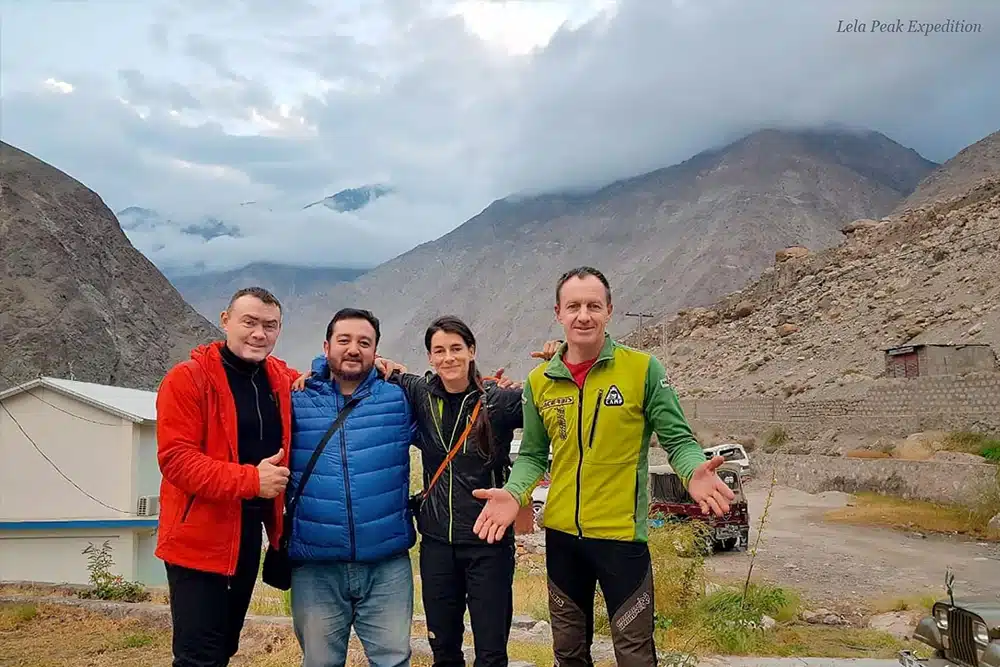
The rope team – Denis Urubko and Maria Cardell
Urubko, a Polish-Kazakh mountaineer, has summited an impressive 28 times. He is the 15th person to climb all eight-thousanders and the eighth to accomplish this feat without supplemental oxygen.
Urubko can also note two first winter ascents: Makalu and Gasherbrum IIIHe opened up new routes on the south side of the Cho oyu, at Manaslu, at Broad peak and at Gasherbrum II.
For Maria "Pipi" Cardell, Nanga Parbat was the fourth eight-thousander of her alpine career. The Spaniard is a ski rescuer and part of the Spanish elite mountaineering team.
It will be an authentic new route, not a variant presented as a standalone route
Urubko
To the summit in five days – ascent in pure alpine style
After an acclimatization period in the Skardu region, Urubko and Cardell climbed directly onto the west flank of Nanga Parbat—over previously uncharted terrain, as Urubko explains. The ascent was quick and efficient: On July 10, they stood at the highest point of the ninth-highest mountain in the world.
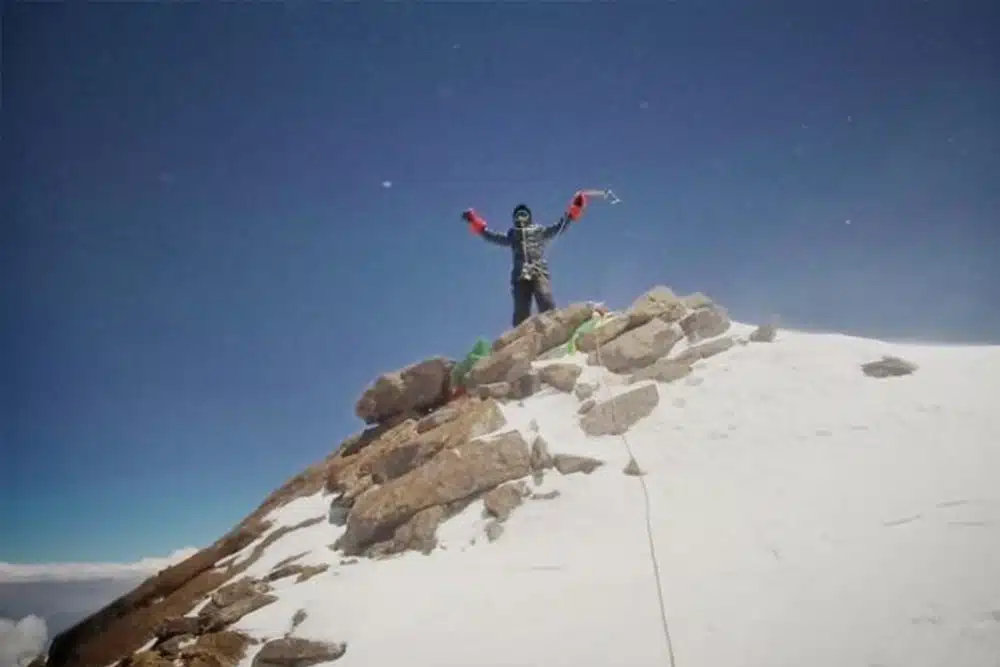
On July 10, at 11:30 a.m. local time, we stood on the summit of Nanga Parbat after climbing it via a new alpine-style route […] Maria and I are happy
Denis Urubko
In a brief statement, Urubko spoke of a perfect moment and an extremely harmonious team effort. "Niezabudka" runs through varied terrain, with ice, rock, snow, and a glacier. It is technically demanding and, in some sections, likely exposed to avalanche and rockfall danger. Wind speeds of up to 90 km/h did not make the climb any easier for the two.
New tour or variation?
Since the publication of the topography, initial voices have been raised that believe it is merely a variation of the 2009 Göschl Route, not a completely new route. Initial topo comparisons show that the route may in some places run parallel to the Göschl Route, which at that time also led toward the summit via the northwest flank.
Urubko and Cardell apparently climbed further to the right of the wall and then crossed the Göschl/Rousseau route at approximately 6.600 meters. "But [our route] continues along the ridge, while the other team continued along the glacier," Urubko said. Cardell also explained that the rope team was well informed about the 2009 route, as they had spoken with Rousseau beforehand.
To someone unfamiliar with the terrain, it may appear to be the same line, but the distance between the two routes is great; anything else is speculation
Maria Cardell
An independent assessment by alpine institutions is still pending. Whether Urubko and Cardell actually explored unexplored terrain or used a creative detour around existing routes remains open.


You may also be interested in
- New 8000m speed record: Vadim Druelle climbs Nanga Parbat in 15h 18 min
- Urubko's winter expedition on Gasherbrum I ends with a fall into a crevasse and frostbite
+ + +
Credits cover photo: Denis Urubko
*Correction: There was an error in this article. It was originally reported that the route name Forget-me-not (depending on the transliteration from the Cyrillic alphabet, Niezabudka, or e.g., Nesabudka) is the Kazakh word for the forget-me-not (Myosotis). A reader's letter rightly pointed out to us that the Kazakh mountaineer named this route not after the Kazakh, but after the Russian name of the plant mentioned. The correct Kazakh name for the forget-me-not is, of course, Botaks (Botköz, to etymologie). With the route name, Urubko pays tribute to the plant, whose beauty and frequent occurrence in the Nanga Parbat region was already described by Fritz Bechtold in his expedition report of 1934 (Fritz Bechtold: Deutsche am Nanga Parbat, Bruckmann Verlag, 1935; page 29).
Translated from Kazakh by an AI??: "...since the publication of the topography..."
Such a passage is unworthy of a specialized publication! Please proofread the text.
Greetings to the new editorial team