


A frozen waterfall high above the Pitztal valley. The weather: ideal. Not too warm, not too cold, the sun peeking through the clouds now and then. Together with professional athlete Ines Papert, Gwen from LACRUX embarks on a multi-pitch ice climb. This unique opportunity allows her to learn a great deal – from route planning and avalanche awareness to precise ice-cutting techniques. Also along for the ride: the CAMP X-Dreams ice axes and Alpinist Tech crampons, put to the test.
Powered by CAMP
tour
I meet Ines at the "Eis Total" festival grounds in the Pitztal Valley. She's obviously just as excited about the tour as I am. Full of motivation – typical Ines Papert. First, we look at the gear. What do you need for a multi-pitch ice climb? It's not that much more than on rock. However, I don't often carry the most important pieces of equipment for climbing on frozen water: ice axes and crampons. Martin from CAMP recommends the X-Dreams ice axes and the Alpinist Tech crampons. We also pack nine ice screws, a belay device for each person, two half ropes, ice clippers, an ice hourglass threader, plenty of quickdraws, slings and locking carabiners, a knife, and some cord. I'm really looking forward to it – I'm sure I'll learn a lot from the multiple ice climbing world champion. Ines knows the Pitztal Valley around St. Leonhard like the back of her hand. There are countless lines here, and we decide to just set off and see what catches our eye.
Right at the start, she explains to me that we should choose a route on the left side of the valley. Since we're climbing early in the morning, the line is still completely in shadow. The ice is compact, cold, and provides good support. It offers exactly the conditions one could wish for on a longer ice climb. Lines that are exposed to sun in the morning quickly become soft, which significantly affects both the ice quality and safety.
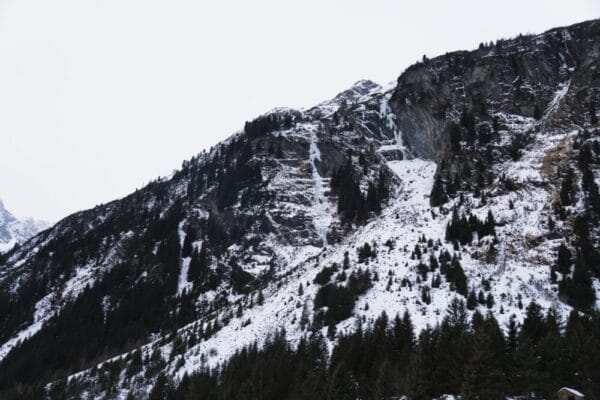
👉 Left and right are ALWAYS assessed in the direction of the valley's flow., Also
from the head of the valley ups towards the valley exit.
The Pitztal valley runs roughly from south (valley end/glacier) to north (Imst/Inn valley). The Pitze river therefore flows northwards.

Which line will it be?
A tour begins long before the first cut into the ice. Familiarizing oneself with the surroundings and current conditions is crucial for safety and route selection. On the side of Alpine Adventure For example, the news section regularly includes information on ice conditions in the Pitztal valley, as well as warnings about sensitive areas with wildlife populations. Knowing these problem areas and acting accordingly is part of responsible planning, which is why you should take the time to find information about the region where you intend to climb.
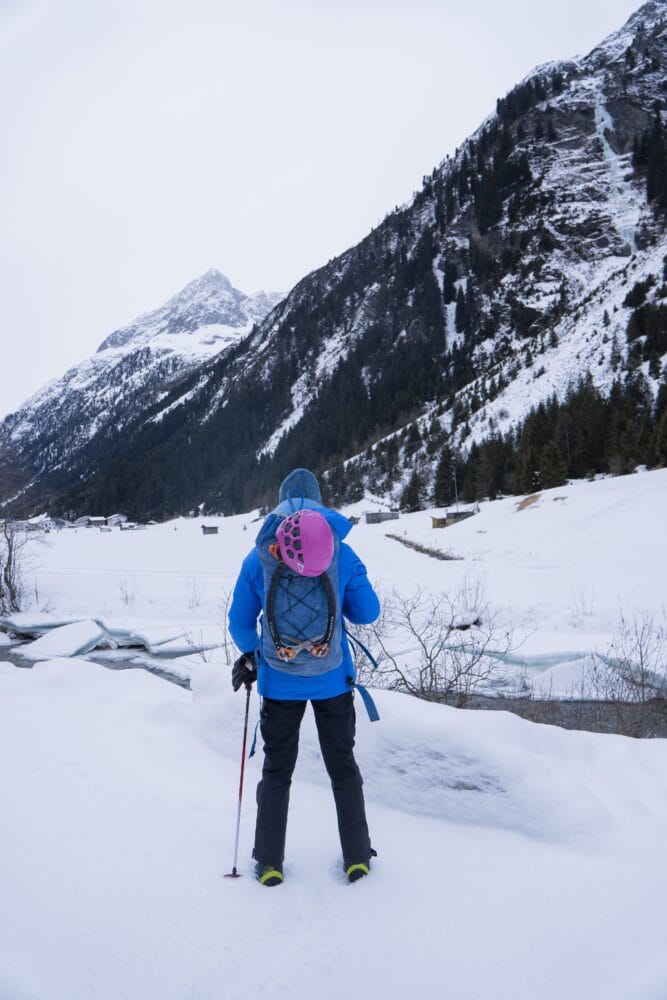
We opted for the "Havana" line, a freestanding ice column near Neurur in the central Pitztal valley. It's one of the most popular routes in the area. Havana begins with a steep curtain climb at WI4, followed by more forgiving, flatter terrain in the WI2-3 range. The final steep column, rated WI6, looks incredibly impressive.
Avalanche science: Ice is never just ice
Even on the approach, Ines draws my attention to a steep gully on the opposite side of the valley. Here, she explains, avalanches often don't release in a wide, sweeping pattern, but rather channel themselves through gullies and hollows. What seems far away from above can become dangerous on the approach: avalanches that release via such gullies pick up speed and can sweep away climbers even on seemingly safe routes. Especially in winter, ice climbing therefore demands alpine thinking – even, or perhaps especially, where you're not yet roped up. Ines advises assessing the approach just as critically as the route itself and consistently carrying an avalanche transceiver, shovel, and probe. Experience helps with assessment, but the crucial factor remains recognizing dangers early and acting accordingly.
Avalanche equipment for the approach
Even though the focus is on the ice line, the approach is often the most avalanche-prone part of the tour, as you ascend without protection. Gully, gullies, and steep slopes – the places where the ice lines run upwards – can be particularly dangerous.
Essential in your backpack:
avalanche transceiver
shovel
avalanche probe

Entry into the line
The ascent begins with a steep climb up an ice column. The ice is well-constructed, slightly soft, and therefore easy to strike. Every strike with the X-Dreams is solid and provides immediate feedback. The Alpinist Tech crampons noticeably ease the climb – even with less-than-ideal footwear (category C mountaineering boots), I find reliable grip. Crucially, the crampons must be placed as straight as possible into the ice; precise front-point work provides stability and confidence, a point Ines will remind me of several times today.
From above, she motivates me and gives me helpful tips as soon as we make visual contact. She shows me good positions for the ice tools and how to make small adjustments to improve my stability. The X-Dreams feel well-balanced in my hand, the balance is perfect, and the impact is precise. Despite this, my forearms are pumped after the first pitch. I still find it quite difficult to trust my feet on the ice and am terrified of dropping an ice tool. As a result, I make a mistake I remember from my early days on rock: I grip the ice far too tightly. Ines has a tip for this too: place the tools securely, then release and shake out your arms.

Precision beats power – climbing with the X-Dreams
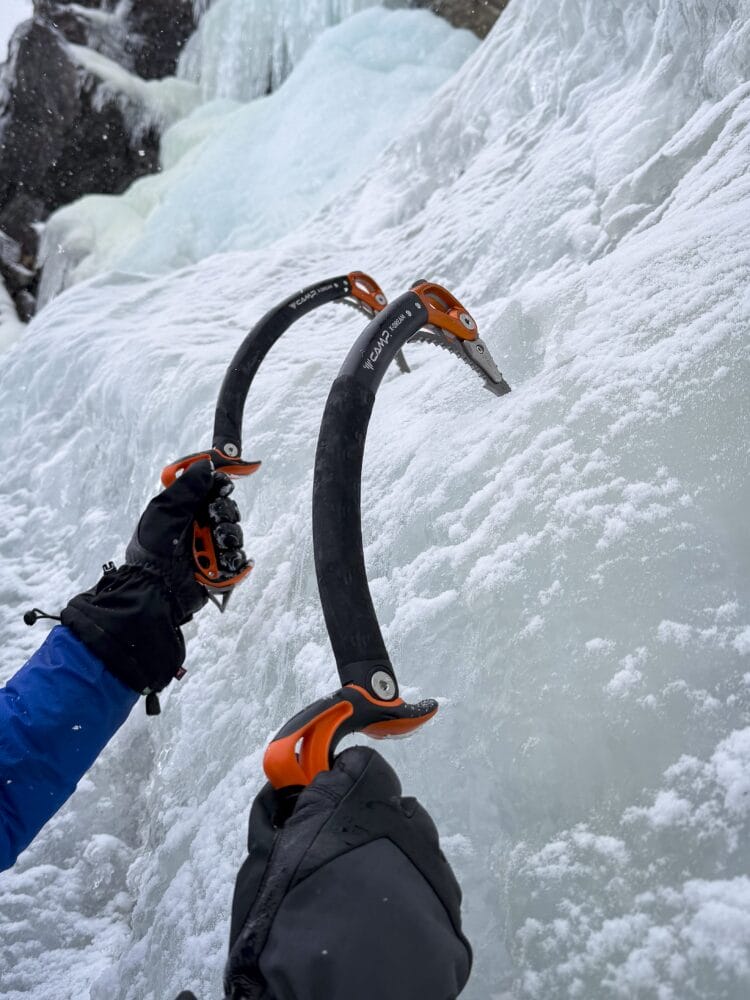
Ice climbing demands precision. I see this when Ines starts climbing. She sees exactly where she wants to place the ice tool, strikes it once into the ice, then again in the same spot, but with more force. The ice tool is in place and holds. I can learn from her. In reality, though, I don't find it as easy as she makes it look. The CAMP X-Dream ice axes, with their ergonomically shaped handles, sit securely in the hand, even with thick gloves. The X-Finger Evo insert is also a great addition, allowing the handle to adapt to different hand sizes and glove thicknesses. When it's my turn to follow, I try to orient myself to Ines's hooks and imitate her movements. The second pitch isn't pure steep ice anymore, which gives me time to concentrate fully on placing the ice tools. In the ice configuration, the impact is very natural, and the pick penetrates the ice efficiently. Especially for someone like me, who doesn't yet have the experience of a world champion, this makes a huge difference. Minor inaccuracies are forgiven without giving the impression of losing control. Overall, the tools are well-balanced, with enough weight in the head for clean and controlled strokes. The pronounced ergonomics do require a short adjustment period, however: those coming from more traditional ice tools will need to adapt to the grip angle. Once you do, the X-Dreams reward you with precision and confidence on every stroke.
Proper footing is a must – Alpinist Tech crampons
On the not-so-gentle third pitch, I realize once again just how crucial precise footwork is. The T-shaped front point of the Alpinist Tech allows for precise foot placement on steep ice. A secondary front point provides additional stability and a very secure feel. This is especially beneficial on small footholds and steeper sections. At the same time, the crampons react instantly to every movement: precise footwork is rewarded, and inaccuracies are less forgiving. This demands concentration but provides control and confidence once you find your rhythm. As with sport climbing, good footwork on ice also means less strain on the arms. Moreover, at around 800 grams, the Alpinist Tech is the lightest model in the Italian company's range.

Rappelling in the snow
When we reached the belay station before the WI6 section, we decided to turn back. The view from Havana was breathtaking. Nearly 200 meters of ice lay below us, and the face continued steeply above. It also started to snow, which made the whole scene even more beautiful. Rappelling in a snow flurry was quite an adventure. When I was about halfway down the rope, it happened: the prusik knot froze solid under my belay device. I'd never experienced anything like that before. New plan: Ines held the rope from below while I continued rappelling. Without the prusik knot. The pulling force from below prevented me from slipping through, and the device locked securely. So, Ines essentially determined how quickly I reached the bottom. We did the same for the next two rope lengths until we reached the base of the waterfall.
I'm completely exhausted, but for Ines, the tour wasn't even a warm-up. She's a fantastic motivator. Her passion is contagious, and she quickly makes you feel confident and secure. Despite our different skill levels, we both had a great time on the tour, and I learned a lot from her as my climbing partner and mentor on the ice.



This article is brought to you by CAMP – proud outfitter of Ines Papert.
You might be interested in: