


Seven pieces from The North Face Summit Series, a week in the Mont Blanc massif: How does the series perform in alpine conditions? Our editor Gwen tested the collection on high-altitude tours and multi-pitch climbs and discovered that the best compliment for mountain clothing is a rather unspectacular one.
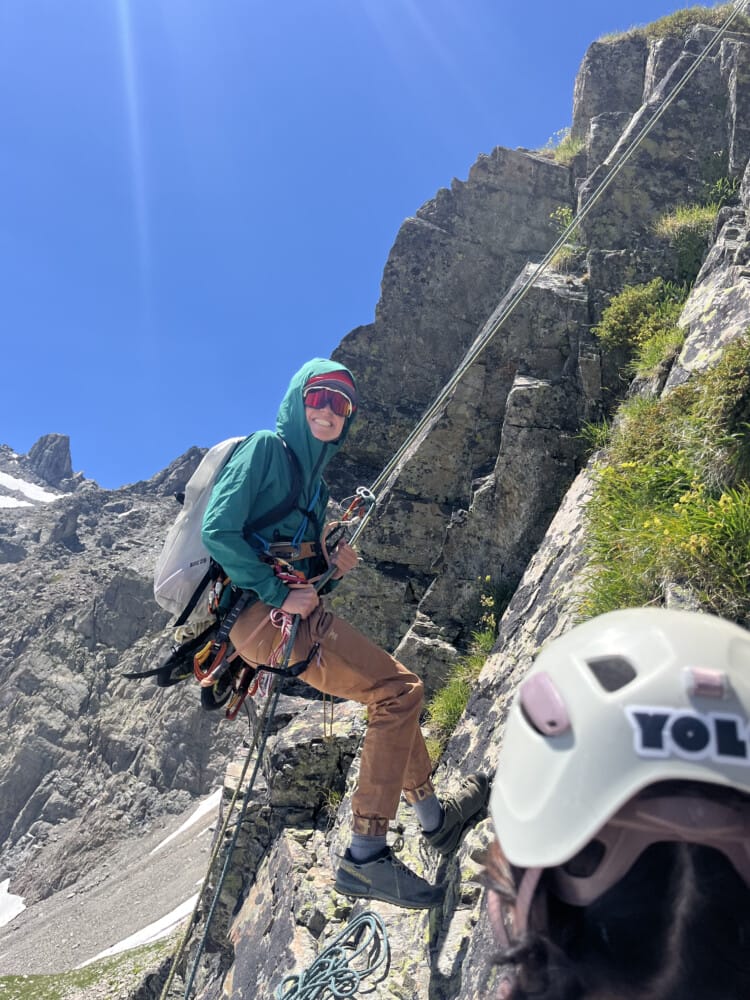
A week in Chamonix means high-altitude tours and climbing until your muscles demand a rest day, because the routes in this "alpine mecca" never disappoint. Glaciers, peaks, and grippy gneiss, plus dream conditions: sunshine and a fresh breeze. We explored the area around the Aiguille du Midi. We also spent several days on various multi-pitch routes in the Index area on the Flégère. Not a rigorous test for the gear collection, but definitely enough tours to put it through its paces.

The jacket: Summit Off Width
My favorite piece from the collection, and maybe even my new favorite jacket. Summit Off Width Jacket My outermost layer was a hardshell jacket for (almost) the entire day while I was on the go. With the mild temperatures, no precipitation or snow, and while moving around, a hardshell jacket would have quickly become too warm.
The material is WindWall, 170 g/m², 89% recycled nylon with 11% elastane. The WindWall principle is the reason I'm so enthusiastic about this series: it reliably blocks the wind and retains warmth without causing overheating. A significantly lighter FlashDry panel, weighing 91 g/m², is located in the center of the back and underarms. This is the built-in ventilation. Therefore, you can wear the windproof jacket all day without overheating.

Moving on to the cut: sleeves extend precisely to the wrist, with a clean finish at the hip. Compared to a hardshell, this jacket fits like a second skin. The hood is helmet-compatible and can be tightened at the back with an elastic drawstring. What also impressed me is how well it seals around the face: close-fitting but not tight, and hardly any wind gets through.


Details of the Summit Off Width Jacket: clean sleeve cuffs and helmet-compatible hood for use on high-altitude tours and alpine climbing.
It's extremely thin and very light. On the descent in Flégère, when it warmed up again at the bottom, it was stowed away in seconds. For alpine climbing and high-altitude tours, this jacket is, in my opinion, an excellent choice. For the sake of transparency, however, here's my only criticism: the pockets are inaccessible when wearing a climbing harness. The waist belt unfortunately blocks them. But this detail won't deter me from buying it; the jacket is simply too good.
The baselayer: Summit Pro 120
The Summit Pro 120 Long Sleeve Baselayer On the Aiguille, this was my warming layer under my windbreaker – and for a while during the ascent, it was my only layer. It's made of DotKnit, a double-knit fabric of 100% recycled polyester, 132 g/m². The construction is designed to actively wick moisture away from the skin and transport it to the outside, and that's exactly what it does: despite sweating, the shirt was practically dry again immediately.

What's also interesting is what The North Face calls "odor-inhibiting technology." I wore the baselayer for several days straight on high-altitude tours – as described above, it's not merino wool, but pure synthetic fiber, and yet there was no odor problem.
The garment fits snugly, as a baselayer should. I didn't feel any seams under my climbing harness; TNF has deliberately opted for a minimal seam construction, designed for layering. I would have preferred the long-sleeved shirt to be slightly wider at the shoulders, but I do have relatively broad shoulders for a woman.


DotKnit fabric, thumb holes and reflectors on wrists and back: the details of the Summit Pro 120.
Combined with a fleece mid-layer and a hardshell, I will continue to use this baselayer on colder tours. I really like the temperature regulation in this series.
The T-Shirt: Summit High Trail
The Summit High Trail T-Shirt I wore it on the Aiguille when it was a bit warmer, to compare it to the baselayer. I also wore it most of the time while climbing.

In short: You can sweat in it easily, it doesn't smell, and it dries quickly. Size S fit well here too, but again, the same issue with the shoulders. Combined with the rest of the collection, it creates a layering system that worked well for an entire week.
The pants: Summit Off Width
The Summit Off Width Hose These are top-notch pants for alpine terrain, period. They didn't bother me once during a week of continuous use. Nothing chafed, wrinkled, or pinched. They feel like a second skin.
The fit is where things get interesting for shorter women. The pants come in eight waist sizes and three lengths: short, standard, and long. I opted for the shorts, and finally, climbing pants that fit me exactly as they should: the Summit Off Width fit my thighs and hips perfectly. They fit snugly at the waist, which can be further adjusted with the integrated belt. They're not too tight around the thighs, and the ankles offer just enough room to comfortably pull them over climbing boots. So, if you're petite and curvy, you should definitely check out these pants. I especially liked the zippered thigh pocket. It doesn't get blocked by the climbing harness and is spacious enough for a phone or similar items. The pants also offer a great deal of freedom of movement; they feel almost like leggings, but made of a more comfortable, highly breathable material.

The Summit Off Width also utilizes WindWall technology, as well as a thinner, more breathable FlashDry panel on the thigh for built-in ventilation. On the Aiguille, at five to seven degrees Celsius, this ensured perfect temperature control during activity and breaks – without a baselayer underneath. If it gets colder or wetter, a baselayer is necessary, or you'll need to switch to a hardshell.

After a week of continuous use, it still looks brand new: no pilling, no tears from contact with rock. My only criticism: the concealed back pocket is inaccessible when wearing a harness. To be honest, I didn't even notice it once during the entire week. The pants are designed for alpine use and perform exceptionally well in that environment: I give them top marks for alpine climbing and high-altitude tours.
The approach shoes: Verto
Also about the Verto approach shoes I can only report good things. The sole is a Vibram Megagrip with 3,5 mm lugs. And Megagrip is the perfect word: on scree slopes, light snowfields, and normal hiking trails – it performs well everywhere. I could jump and climb as I pleased. Edge walking works perfectly, and friction on slabs is also excellent. The shoe has a suede upper. It features an internal stability shank in the midfoot and a reinforced rubber toe cap that extends beyond the midsole. The shoe was truly comfortable from day one. Even after long ascents and descents (sometimes lasting several hours), I had neither blisters nor sore feet.

The North Face describes them as a "regular fit," but I'd say they're a touch smaller, as they could have been a tad bigger for me. If in doubt, try them on. What I can't judge after a week is how long the suede upper will hold up under continuous use. That would require a long-term test.

The socks: Trail Run Merino Crew
The Trail Run Merino Crew Socks They're actually designed for trail running, but they also performed well in the mountains. They fit snugly, don't slip, and I found the slight reinforcement at the ankle and the compression to be quite pleasant.
I also wore them in my hiking boots (La Sportiva Aequilibrium) on the Midi: they came up just high enough and didn't slip down. I used them for two days straight (can I admit that?) with airing them out overnight – and there was no noticeable smell.
The backpack: Phantom 38
At the Phantom 38 I need to explain briefly. The North Face positions it as a backpack for ski mountaineering, and I actually know it from that very area: A friend had it with him on a splitboard tour in the Pitztal at the beginning of the year, and I was already very impressed back then.

It's ultralight, and you can tell. The material is 210D recycled nylon with Spectra ripstop, and the base is additionally coated with TPU. Spectra is an ultra-high-molecular-weight polyethylene fiber, stronger than steel by weight – woven in as a ripstop grid, it prevents cracks from propagating. That's the trick behind "super-thin yet robust".
After a week of continuous use, the backpack has two small holes on the side. I can't really explain where they came from. It doesn't bother me too much; I'll just patch them up – but it was noticeable, and so I was at least able to take a closer look at the ripstop technology. The ripstop does indeed visibly prevent the tears from spreading; however, it unfortunately doesn't protect against pinpoint punctures.

What convinced me from the very beginning (even during the splitboard tour in March) was the packing flexibility and the variety of external buckles. You can open and close everything on the outside and clip items on. It's fantastic that the closure straps can be fully opened for ice axes or ice tools. The ice axe sits really securely on the pack and is attached without any tugging or pulling. It works just as well with the rope. Here you can clearly see that the pack was made for the mountains and that ski mountaineers were considered: skis and splitboards can also be attached to the Phantom without any major problems.


Above: This is how equipment can be attached to the outside of the backpack. Below: The hydration system with space for a three-liter bladder was my best friend on some days.
The backpack also has space for a hydration bladder with a hydration system, a small hip belt pocket for sunscreen or snacks, and 360-degree reflectors. Another clever detail I find is that you can tuck the lid pocket inside and still close the backpack securely, compressing it nicely. Everything is easily accessible if you pack efficiently. However, there are two drawbacks: If you tuck the lid pocket inside instead of on top, rain or snow will get into the backpack – this can be solved by leaving it on top, but then the backpack might not look as pristine as it did in the advertising catalog. Also, you generally have to pack it very neatly to maintain its shape.
It's truly excellent for skiing and mountaineering: lightweight, versatile, and comfortable to wear. The price is also a clear advantage.
The collection – in short:
What I like so much about the series can be boiled down to two things: WindWall and the lightness of the material. It's incredibly comfortable to wear; it's light, it's thin, and yet it regulates temperature, blocks the wind, and is breathable. This combination doesn't come cheap, but I found it to be quite impressive on the mountain. My favorite pieces? The jacket, definitely. And probably the pants too.

While writing this report, I asked myself what the most lasting impression the Summit Series left on me was. And actually, it's the most unspectacular: I didn't have to think about my gear the entire time; I was simply satisfied. With mountaineering apparel, that's really the highest praise.
That might interest you
- Milestone: Fay Manners' ambitious winter mixed trilogy in Switzerland
- Benjamin Vedrines – »K2 Chasing Shadows«
+ + +