


In the spring of 1975, Kurt Albert marked the start of a route in the Franconian Jura with a red dot for the first time. Fifty years later, the term "red dot" has become the definitive free climbing style. Therefore, climbers in the Franconian Jura in Obertrubach duly celebrated this past weekend with a photo project and a film on the history of free climbing.
What does redpoint climbing mean?
In front of Rotpunkt-era, climbing was done with technical aids. In the so-called Techno-Climbing uses climbing aids such as stepladders and pitons for stepping and holding on. The redpoint style revolutionized Kurt Albert 1975 climbing in FrankenjuraThe red dot he drew next to individual routes meant that he had climbed that route free, meaning he had climbed it without any weight-bearing or propulsive aids. Pitons and rope now served only as safety, no longer for progress or rest.
This quickly established itself as the new standard: the redpoint became the guiding principle of modern climbing. Almost all sport climbing routes today, whether on natural rock or in indoor climbing halls, are climbed according to redpoint ethics.

50 years of free climbing – a reason to celebrate
For several years now, passionate climber and photographer Daga of "In the Shadows – Visual Storytelling" has set herself the goal of properly honoring the 50th anniversary of free climbing. This is how the idea for her photo book was born about five years ago: Franconian Jura: Half a century of drilling holesThe whole project was under the motto »50 photos of 50 climbers in 50 routes for the 50th anniversary of the Redpoint. "
Daga was fascinated by the history of the Franconian Jura. From the classic routes to the pioneers of free climbing and the red dot. For her, this is all history that deserves to be told and preserved, especially now that the climbing community continues to grow.
People used to tell stories around Grandma Eichler's campfire, but those stories are slowly disappearing, and I think that's a shame. That's why I'd like to tell them again.
The 50 climbers depicted in her book all have a connection to climbing in the Franconian Jura, which gives the whole project a further nostalgic touch. For the artist, the whole project is a for the community: "Either you do it with passion, or you don't do it at all." She tells us at the opening with a smile.
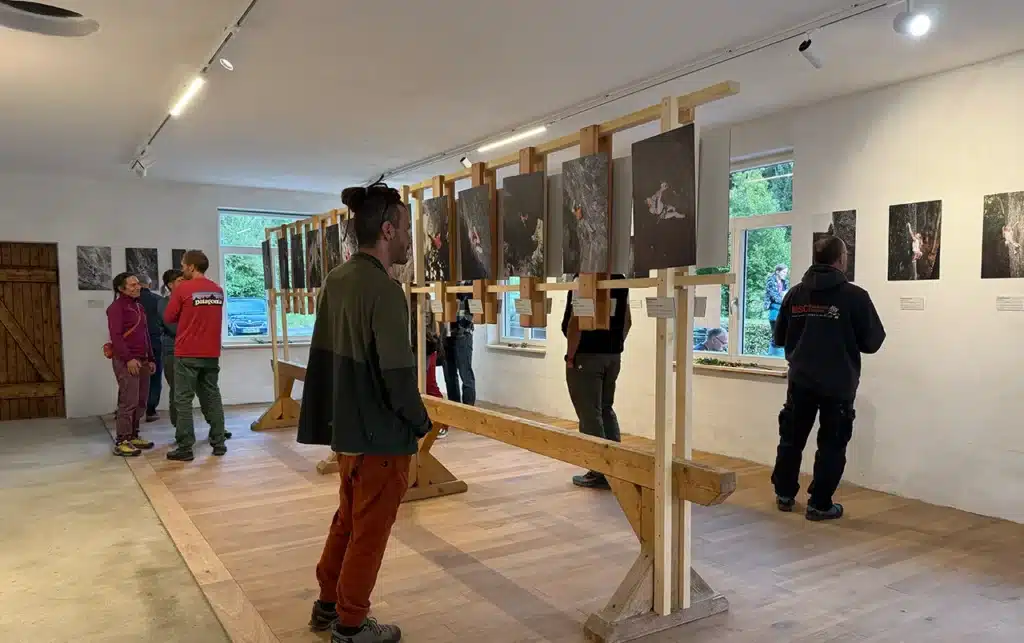
Vernissage at the Schlöttermühle, Obertrubach
Last Saturday, Daga's exhibition opened in Obertrubach, and she invited the community to join her for climbing, a campfire, coffee, and cake. It was a wonderful event that once again highlighted the core of her project—the community.
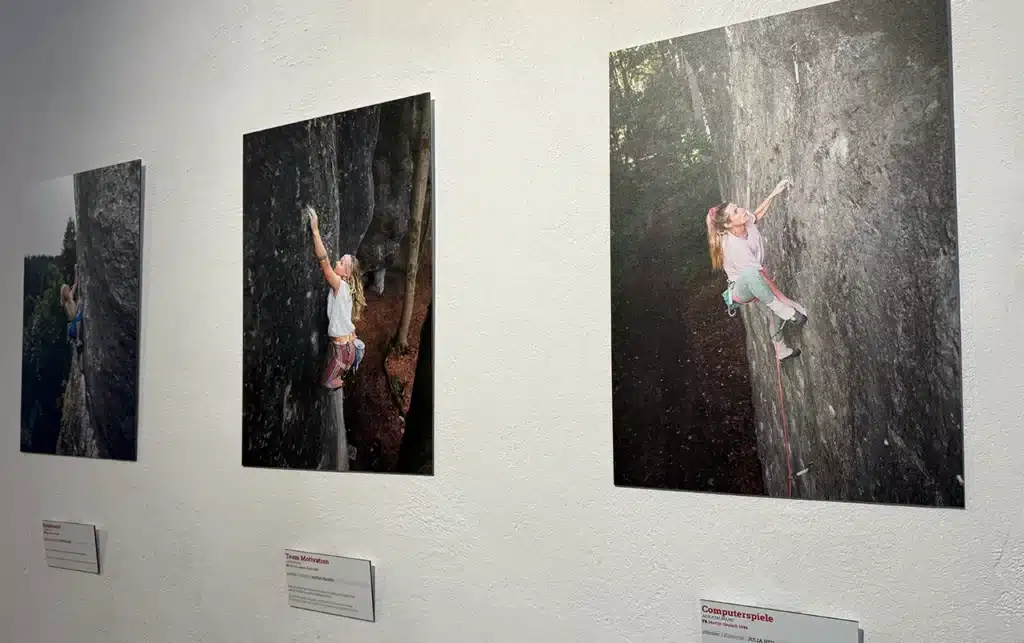
The exhibition is also much more than just 50 pictures: Daga conducted extensive interviews with her models about climbing, the selected routes, and their personal relationships with the Franconian Jura.
We were also able to see the first 30 minutes of Daga's film about the redpoint idea, in which veterans of free climbing in the Franconian Jura and around the world, such as Norbert Bätz, Stefan Glowacz, Milan Sykora, Jerry Moffat, Antoine Le Menestrel, Stefan Koch, Andi Hoffmann and Manfred Eichhorn, passionately talk about the early redpoint years, Kurt Albert and the community at that time.
All in all, a very personal, passionate project and definitely worth a visit. All 50 images and their book are on display at the Schlöttermühle in Obertrubach until September 28.09.2025, XNUMX, and are perfect for a visit after a long climbing session!
You can find more information about the project, the exhibition and the climbers here.
You might be interested in:
- A tribute to the red dot revolution
- About injuries and projects: Interview with Franconian Jura climber Heiko Queitsch
Credits: Images Lacrux Editorial