


A report by Sarah Ritscher and Severin Parger
We had the opportunity to test the new brake assist EDELRID OHMEGA to test it intensively over a period of about two months, both in the climbing gym and on the rock. There's a weight difference of about 25 kilograms between us. This quickly becomes a challenge, especially when belaying and lowering the heavier partner. Especially for beginners like Sarah, who aren't yet completely confident with rope handling, this often creates a queasy feeling. This is precisely where the OHMEGA comes in – and has changed many things for the better for us.
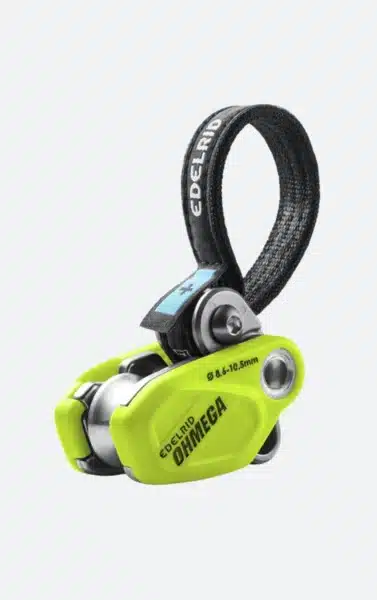
But the OHMEGA is also an ideal companion for advanced and professional climbers, as the device, with three individually adjustable braking levels, responds optimally to different rope teams – even with the same weight difference. The integrated pulley ensures minimal rope friction, which significantly improves handling, especially on long, difficult routes. The precise braking effect noticeably increases safety during lowering and falls.

Application & braking effect in practical tests
The device is designed, among other things, to compensate for various weight differences between climbing partners. With three individually adjustable braking levels, which can be easily adjusted using an integrated HMPE sling, the compensation value can be adjusted to suit the situation (at least 10 kg, 20 kg, or 30 kg). The climber thus becomes lighter by the set amount. For us, this meant: no more frantic counter-holding, no more crashing into the wall, no more fear of lowering the partner too quickly – but rather a calm, controlled belay. The difference was immediately noticeable, especially during lowering: The braking effect is reliable, without the need for constant manual adjustments.

Operation & technical details
Another huge plus point is the user-friendly manual. The instructions are clear, well-structured, and explained in a practical way. Even after reading it through for the first time, it was clear to us how the OHMEGA works, how to adjust the settings, and what we needed to pay attention to. There was no uncertainty—we were able to get started with the device right away.
The OHMEGA also impresses technically with its integrated pulley, which significantly reduces friction in the first intermediate anchor. This makes clipping easier – especially on longer routes – and ensures a more pleasant climbing experience. Less rope pull, less effort, and therefore more concentration on the actual route as a climber and on belaying as a person on the ground. The spring-loaded clamping lever prevents false activations during rapid clipping.
Another advantage of the OHMEGA: Thanks to the short loop, the distance the device has to travel to activate is minimal. This helps the belayer find the right timing for dynamic and soft belaying. In the event of a fall, the braking mechanism activates automatically, depending on the selected braking level. This reduces the fall energy early, before the belayer has to intervene significantly. The fall height is thus significantly shortened, greatly reducing the risk of a fall to the ground, especially in the first few meters.
Weighing only approximately 190 grams, the OHMEGA is very lightweight and can be carried discreetly on a harness or in a backpack. It's barely larger than a standard quickdraw, but the difference in handling is enormous.

Of course, there are limitations here too: On steeply overhanging routes or with inclined rope guidance, the device may jam or the rope may be difficult to pay out. In such cases, some patience and sensitivity are required, or perhaps a lower compensation level on the OHMEGA.
Nevertheless, compared to the other members of the OHM family, the handling is significantly improved and overall appears more sophisticated and intuitive. Indoors, it's important to use a smaller carabiner, as the fixed quickdraws leave no room for larger carabiners.
And another clear statement from us: We would exchange our current OHM II for the new OHMEGA exchange. The improvements in detail and the increased sense of security speak for themselves.
Hard Facts
- Weight 190 gr
- Approved rope diameter: 8,6 - 10,5 mm
- 3 braking levels, individually adjustable
- Only suitable for single ropes
Conclusion
The EDELRID OHMEGA was a real game-changer for us as a climbing couple with a significant weight difference. Sarah believes the OHMEGA is perfect for beginners, as she's only been climbing for a year and was able to immediately find her way around the OHMEGA. For me, as an experienced climber, the OHMEGA is a huge asset when I'm out climbing with Sarah at climbing gardens or indoor climbing centers. The safety of the OHMEGA allows me to deliver perfect performance on my more difficult routes despite our significant weight difference. The device is only noticeable when needed. Not only does it increase safety, but it also promotes mutual trust—a crucial aspect of climbing. Its ease of use, clear instructions, and compact design make the OHMEGA a well-thought-out braking assistant that's certainly useful for both beginners and experienced climbing partners.
We wouldn’t want to be without the OHMEGA in our equipment anymore.

About the author

Severin is a passionate alpinist and has been in the mountains since childhood. As a member of the Austrian Friends of Nature's Alpine Team (2020-2022), he has traveled throughout the Alps and completed his final expedition in the wild mountains of Kyrgyzstan. His favorite disciplines are alpine climbing, ice climbing, and ski touring.
- The ultimate endurance test for the Edelrid Pinch
- Simon Gietl: “For me, the Edelrid Rage is currently the coolest ice tool.”
+ + +
Credits: Text, content and photos by Sarah Ritscher and Severin Parger