


The four female alpinists Caro North, Amelie Kühne, Julia Cassou, and Belèn Prados climbed the "South African Route" (5.12 c/7b+ 1200m) on the east face of Central Tower, Torres del Paine, Patagonia. Anna from Lacrux spoke with Caro and Amelie directly after their adventure to tell you about it.
Sometimes there are those special moments when a story subtly connects with a feeling. When I heard about Caro, Amelie, Julia, and Belèn's expedition, I immediately felt the Patagonian wind on my skin: sometimes gentle, sometimes stormy, always unpredictable and full of adventure. I thought of Caro's favorite song, "Cuatro Vientos" by Danit—not just because of the Patagonian winds, but because of the feeling behind it: this being on the move, this courageous commitment to something bigger than oneself.
Viento que viene de la montaña.
A wind coming from the mountains.
Viento, tráenos la claridad.
A wind that brings us clarity.
Viento que viene del mar.
A wind coming from the sea.
Viento, tráenos la libertad.
A wind that brings us freedom.
Vuela, vuela, vuela, volá con nosotros.
He flies and flies and flies with us.
Four winds – four female alpinists. In Patagonia, winds have a direction, a force, and a will of their own. They come from all directions, swirl, build up – and then collapse again. They determine when you climb, when you wait, and whether you can even continue. At the foot of the towers in Torres del Paine, the Patagonian weather isn't background noise, but rather the driving force. Caro, Amelie, Julia, and Belèn follow this rhythm precisely.

One team, one goal
Just as the winds in Patagonia converge from all directions, these four women come from vastly different worlds: Caro North, a mountain guide and professional alpinist since her time on the German women's national team, lives half the year in Patagonia and half the year in Switzerland. She was the link and driving force behind this expedition. Amelie Kühne, a promising young German alpinist and climbing talent, lives in Austria as a student and was the youngest woman in the group. With her keen eye for detail, the French photographer and passionate climber Julia Cassou completed the team, as did Belén Prados, a biologist working in Argentina who shares the passion for climbing with the other three women. Four routes converging on a common line: the South African Route on Torres del Paine (7b+/5.12c, 1200 m). The shared goal of the four alpinists: the first female ascent. Their journey there is marked by stormy challenges, a breeze of doubt and unpredictable weather changes – and the realization that nothing in Patagonia remains entirely predictable.

Big wall climbing in Patagonia
The approach alone makes it clear that Patagonia has its own rules. From Puerto Natales, the route leads to the Campamento Torre base camp, then onward toward the wall. It takes about four hours to reach base camp. From there, it's another three and a half to four hours to reach the base of the east face of Torres del Paine. Long approaches are nothing unusual for the four female climbers – were it not for the seven haul bags, weighing an estimated 250-300 kg, that they have to carry. "Big wall climbing involves so much logistics! Sometimes you just have to make decisions and hope for the best," Caro sums it up. Their packs include 450 meters of static rope, two portaledges, six racks of Camalots, 97 liters of water, and food for up to 17 days. "Two to four liters per person per day is usually the guideline. We had 97 liters because we were expecting snow." "That's always difficult, because if you can't find enough snow and the water runs out too early, you have to go back down," Amelie adds.

The four women made the ascent several times to transport all the equipment to the wall. "After carrying the equipment up, we spent the night at base camp," explains Amelie, "We knew it would get cold enough later."

Two weeks of climbing time were planned. 28 pitches on granite, 1200 meters of climbing. Self-built belay stations using mobile protection and pitons. Five weeks of expedition time. Five weeks of adventure. What sounded like a long stay turned into a race against time. "We hadn't realized how much effort it takes to carry all the gear to the bivouac, then to the base of the wall, and finally up to the tenth pitch. The days just flew by," Caro sighed.
Fragile start
The route begins where a glacier once stood. Due to progressive climate change, the glacial ice has retreated further and further – so much so that the first ten pitches were only just formed. The rock in this area is correspondingly characterized: brittle, unstable, and difficult to protect. "Between our first and second time at the base of the wall, the glacier receded several meters – just like we do from the beginning to the end of the season," explains Caro, who studied geosciences and environmental sciences before her mountaineering career. This explains why the first ten pitches feature such different, so challenging, rock.

“We were climbing incredibly slowly because it was so difficult to place good protection,” Amelie said worriedly. Above them, other climbing parties were making their way up the wall, and the four women kept hearing rocks falling. Suddenly, it happened: Belén was hit by a rockfall. Luckily, she didn't have an open wound. She descended with Caro for the day and returned to the bivouac to rest and make sure she wasn't more seriously injured. Fortunately, it was only a bruise, and Belén didn't need medical attention. She recovered quickly and soon climbed back up to Julia and Amelie with Caro. The rockfall the women were experiencing finally subsided. “Rockfall is really scary because you can't control it,” Caro explained, describing her worries. “But thankfully, it finally stopped.”

As the four women laboriously and much more slowly than hoped worked their way through the first few pitches, the route finally emptied. The other climbing parties had left, and the wall above them was now clear. For the four climbers, this meant significantly less rockfall. Considerably less objective danger. "Otherwise, I wouldn't have started," Amelie sighed. Looking at the map and the topo, she had assumed that the difficulties would be concentrated mainly in the upper crux pitches and that the start would be relatively moderate. Reality was different. "I was surprised how alpine it was. There weren't just cracks, but a lot of slabs—with horrendous runouts. Runouts on micro holds."

What follows from this moment on is pure adventure climbing and a great deal of improvisation just to get to the top safely. And all this with seven haul bags. Three and a half days of climbing, hauling, fixing, and waiting – for the first ten pitches.
Life in the portaledge
On the tenth pitch, they fix their portaledges and set up their first camp on the wall. From there, they climb, haul, and fix ropes. When big wall climbing at this difficulty level with so much gear weight, the portaledges aren't carried pitch by pitch. Instead, a camp remains in place while the subsequent pitches are climbed and then fixed with static ropes. After spending the night at camp, the already climbed pitches can be traversed using the fixed rope, and climbing from the same point is possible the next day—with the least possible time lost to get back to that point.

For this reason, the four women opted for one camp after the tenth pitch and another after the seventeenth. The day they dismantled the camp and hauled the portaledges up was particularly strenuous and strategically delicate. "You're most vulnerable when you're dismantling and carrying the portaledge," Caro emphatically points out. The Patagonian weather, which can change quickly and suddenly, poses one of the greatest dangers on a wall of this magnitude. Without the portaledges set up, the climbers were unprotected on the rock face. "We set off from our first camp at Shattered Pillar to carry the portaledges to the second camp at Boeing Ledge. The weather forecast for that day was really good! But in the end, it was unfortunately the worst day we could have chosen," Amelie reports. "It snowed that day, and there was a lot of spindrift." “We climbed seven rope lengths and set up the portaledges in the snowfall,” Caro adds, “Standing still became dangerous. It was freezing cold.”
The following day finally brings some sunshine. Wet clothes and snow-covered materials can dry.
The battle with the weather
Snow covers the portaledges. The temperatures are dropping. The climbing is changing. Caro shakes her head: "We couldn't free climb everything because it was so cold. We had to climb in mountaineering boots in some sections." Conditions are becoming difficult: snow is in the cracks, and icy holds have to be chipped free. "It became clear relatively quickly that we had to decide whether to try to free climb the difficult pitches or try to reach the summit," Caro explains. Amelie also reports on the challenging winter conditions that blocked a free climbing attempt: "We didn't have any chance of free climbing at all because it was so incredibly cold and there was so much snow. I had a really good attempt on the first of four difficult pitches. I was so happy! Unfortunately, I fell once on that pitch. After that, the wall was so covered in snow and ice that we only attempted the remaining difficult pitches onsight, not multiple times." But the adventure is far from over. Amelie suffered mild frostbite on her foot and trembled for the summit: "I was afraid that I wouldn't be able to make it on summit day. My foot was badly swollen."

Eleven more pitches, including the summit ridge, await the four female alpinists. In the most wintry conditions, they continue to fight to reach their goal: the summit of the east face of Torres del Paine and thus the first all-female ascent of the "South African Route".
Onward to the summit – “The day was simply there for us”
After days full of storms, snow, and doubt, suddenly this one window of opportunity appears: sunshine. No wind. Clear visibility. "The summit day was the first completely beautiful day," laughs Amelie, "The day was simply perfect for us."
The four women started from the portaledge camp on Boeing Ledge, at the end of the 17th pitch. They ascended 320 meters on a fixed rope, attempting the final climbing meters to the summit. They traversed icy sections and seemingly endless pitches, climbing ever higher. "One of the last pitches was 60 meters long and felt endless! I don't think I've ever climbed such a challenging pitch in my life: ice on the holds, snow in the cracks, and bitter cold. These conditions made even easy terrain just as difficult," Caro emphasized.

At 16:00 PM, Caro, Amelie, Julia, and Belén stand on the summit. 1200 meters of rock face lie below them. All pitches of the South African Route. The first time in Torres del Paine for the entire team. The first complete ascent of the "South African Route" by an all-female team.
Is it over? The tour isn't finished until everyone is back in the valley.
A climb only ends when everyone is safely back down. Even the retreat takes time and energy: rappelling, carrying static ropes, building belay stations… At midnight, the four mountaineers reach their camp at Boeing Ledge. The following day starts early. The group has barely slept, but the clock is ticking: Caro and Belén have to reach Bariloche two days later to go to work – Caro as a mountain guide, Belén as a biologist. So, a race against time begins: the remaining water is emptied to make the haul bags as light as possible, and the four women try to make the descent only once, due to time constraints. This means carrying really heavy backpacks – and this at the end of a five-week expedition. “Caro and Belén had to go to work. It was the only day with good weather that became our summit day. It couldn't have been a day earlier or later. We made it perfectly,” Amelie reports proudly.

A complete success
The first free ascent by women remains unfulfilled – but nothing about this expedition is a failure. "I wouldn't see it as a fail," Amelie laughs, "It was so incredible that we even made it up there." Caro sums it up perfectly: "That was definitely one of the most challenging things I've ever done: so steep, so demanding, so long, and then there was the Patagonian weather." Of course, I also ask them the The question of all questionsDo you want to go back there again?

Neither of them hesitated with their answer: "Yes. For me, it's unfinished business – I want to go back and free climb everything. Many of the pitches are cool, and the crux pitches offer incredible climbing. I'd do it all again for those," Amelie replied confidently. "I would definitely do something like that again too. It was a really cool adventure," Caro answered with a twinkle in her eye.
Big wall climbing in Patagonia – contrast and dream?
Caro, who has been living in Patagonia for half the year for quite some time, has already gained considerable experience dealing with the Patagonian weather. However, climbing a big wall in the Patagonian wind was a first even for this experienced alpinist: "I absolutely love climbing big walls, spend half the year in Argentina, and therefore know the Patagonian weather conditions very well. However, I had a lot of respect for climbing a big wall in the Patagonian wind. I always thought it would be awful. But when Spanish friends who had climbed Riders on the Storm on Torres del Paine told me that it wasn't actually that windy, I became curious."
The east face of Torres del Paine is one of the more sheltered corners of the massif. There are days when winds whip through the rocky peaks at 100 km/h, yet climbers remain protected on the east face. "That was my 'aha' moment. Amazing. There are big walls in Patagonia where you can climb and aren't constantly exposed to the wind," reports Caro.
This moment marks the starting point for her to take the initiative and launch this adventure. As in the song. Four winds A wind also blows through this story – not as a storm on the east face, but as a metaphor for the thirst for adventure. Four female alpinists, each in her own way, follow this wind of curiosity – full of the courage to venture into the unknown. The wind of adventure carries on, and with it the four women, ready for their next great goal.

About the author: Anna Truntschnig
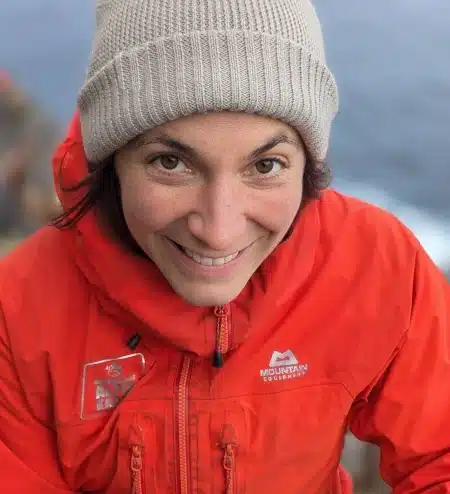
Anna Truntschnig comes from Carinthia and discovered climbing in 2016 – and has been hooked ever since. What fascinates her about alpinism is its versatility: ice, mixed, rock – each discipline demands something different, there's always something new to learn, and that's precisely what appeals to her. For three years, Anna was part of the Austrian Alpine Club's (Naturfreunde) alpine team, culminating in an expedition to Kyrgyzstan. For Anna, climbing combines a thirst for adventure, the joy of movement, and camaraderie – because the most beautiful moments are those shared together.
You may also be interested in
- Finger taping – 3 common taping methods
- Finger strength: Training exercises and methods in the ranking
+ + +
Credits: Cover photo: Amelie Kühne