


Polish mountaineer Piotr Krzyżowski now officially holds the Guinness World Record for the fastest ascent of Lhotse and Everest without supplemental oxygen. He completed the climb in 1 day, 23 hours, and 22 minutes, beating the previous record by almost five days.
Back in May 2024, Piotr Krzyżowski caused a stir with his double ascent of Lhotse and Everest His achievement caused a sensation in the mountaineering community. Now, the 45-year-old Pole's feat has been officially certified: Guinness World Records has awarded him the title for the fastest ascent of Lhotse and Everest without supplemental oxygen.
I don't climb for records – summiting Lhotse and Everest in a single push without descending below Camp 4 was simply one of my mountaineering dreams.
Piotr Krzyżowski
1 day, 23 hours, 22 minutes
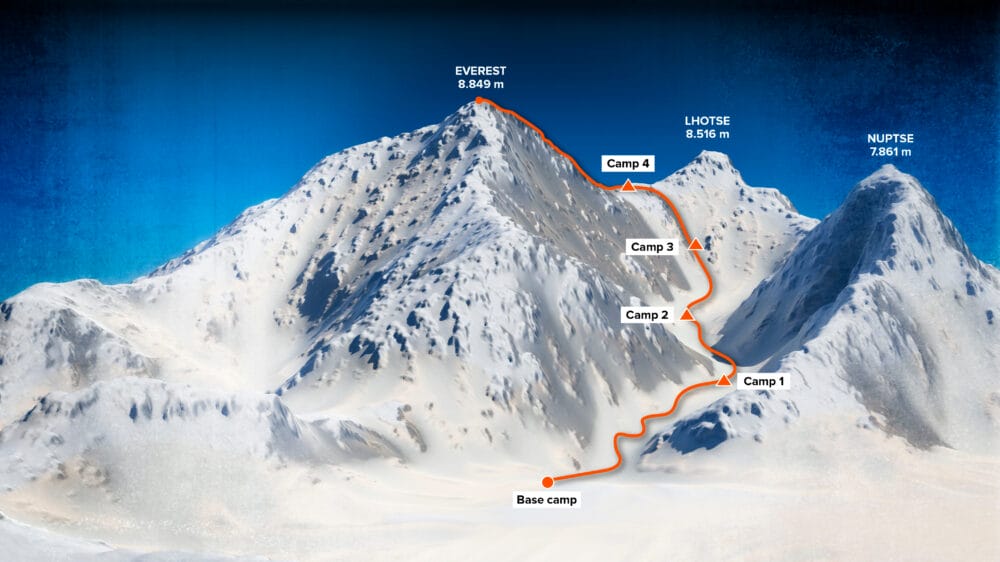
On May 21, 2024, at 14:38 p.m., Krzyżowski stood on the summit of Lhotse (8.516 m). His official expedition goal had initially been a solo ascent of Lhotse without supplemental oxygen. Originally, only a solo climb of Lhotse was planned, but Krzyżowski had already considered the possibility of a double ascent. Instead of descending to base camp, he descended the Lhotse face to the South Col (Camp 4), rested there, and began his summit attempt on Everest that night. On May 23 at 14:00 p.m., he reached the highest point on Earth (8.849 m).
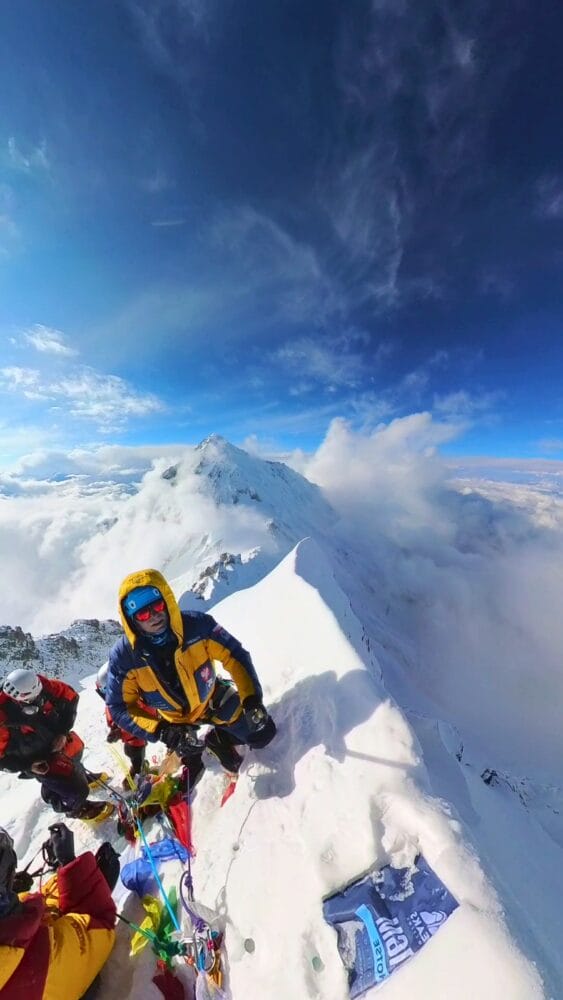
Without oxygen, without Sherpa support, without descending to base camp
What sets Krzyżowski's achievement apart from most altitude records is his style: He climbed both eight-thousanders without supplemental oxygen, without Sherpa support, and without descending to base camp between summits. He explained to us: "My friend and boss at the Seven Summit Treks agency, Dava Chhang, nominated me for the Guinness Book of Records. I was surprised by the entry myself, but it's nice to be in the Guinness Book of Records with a serious record."
The previous record holder: Juan Pablo Mohr Prieto
Krzyżowski's achievement significantly surpassed the previous record held by Chilean mountaineer Juan Pablo Mohr Prieto. In May 2019, Mohr Prieto completed the double ascent of Lhotse and Everest without supplemental oxygen in 6 days and 20 hours. He climbed Lhotse on May 16, 2019, and reached the summit of Everest on May 23, 2019 – also without Sherpa support, but with a stopover at Camp 2. The architect from Santiago was the first Chilean to climb Everest without supplemental oxygen and aimed to summit all 14 eight-thousanders in this manner.
Further Guinness records on Everest and Lhotse at a glance
The double ascent of Everest and Lhotse is recorded in the Guinness World Records in various categories. Two factors are crucial for classification: First, the direction, i.e., whether Everest is climbed first and then Lhotse (Everest – Lhotse) or vice versa (Lhotse – Everest). The Lhotse – Everest route is considered more challenging, as the higher peak awaits after the first eight-thousander. Second, a distinction is made between ascents with and without supplemental oxygen.
Fastest Everest–Lhotse traverse using bottled oxygen (men): Mingma Dorchi Sherpa (Nepal) first summited Everest on May 27, 2019, and then traversed via the South Col to Lhotse in just 6 hours and 1 minute. He reached the summit of Everest at 00:44 and Lhotse at 06:45. Both ascents were made using supplemental oxygen.
Fastest Everest-Lhotse traverse without bottled oxygen: Nirmal "Nims" Purja (Nepal) completed the Everest to Lhotse traverse without supplemental oxygen in 25 hours and 1 minute. He summited Everest on May 15, 2022, at 09:00 AM and reached the Lhotse summit on May 16 at 10:01 AM. During the same period, Purja also set a record for climbing Kangchenjunga, Everest, and Lhotse without supplemental oxygen in just 8 days, 23 hours, and 10 minutes.
Fastest traverse Lhotse–Everest (women): Chinese climber Qu Jiao-Jiao took 21 hours and 30 minutes to summit Lhotse and Everest on May 20th and 21st, 2018. She reached the summit of Lhotse at 08:20 a.m. on May 20th and stood atop Everest at 05:50 a.m. on May 21st. The record was set using bottled oxygen.
Who is Piotr Krzyżowski?
Piotr Krzyżowski hails from the Polish Beskid Mountains. A lawyer by profession, he volunteers with the Polish Mountain Rescue Service (GOPR). He gradually built his experience in high-altitude mountaineering, with ascents in the Tatras, the Alps, the Caucasus, the Pamir Mountains, and the Tian Shan. In 2019, together with Mariusz Hatala, he achieved the first Polish winter ascent of Khan Tengri (7.010 m) in the Tian Shan, for which they were awarded the prestigious Polish mountaineering prize, the "Taternik."
He climbed his first eight-thousander, Gasherbrum II, in 2021. The following year, he summited Broad Peak and K2 within just nine days. In 2023, Nanga Parbat and Gasherbrum I were on his itinerary, meaning he had climbed all five of Pakistan's eight-thousanders. With Lhotse and Everest, he brought his eight-thousander collection to seven summits in May 2024.
Since setting the record, Krzyżowski has remained true to his minimalist style: In May 2025 he climbed Makalu (8.485 m), followed by Manaslu (8.163 m) in September and Dhaulagiri (8.167 m) in early October. His collection of eight-thousanders now stands at ten.
You might be interested in:
- "Weather Stein Ridge" – Michi Wohlleben releases film about his record ascent
- Age records: 16-year-old and 86-year-old climb Manaslu
+ + +
Credits: Cover photo: Piotr Krzyżowski