


Frozen waterfalls, steep approaches, and cold belay stations: Norway is one of the most impressive destinations for ice climbers in Europe – but it also places high demands on equipment and clothing. Ice climber Anna embarked on a winter trip through Norway and tested two models from Mountain Equipment.
This article was created in collaboration with Mountain Equipment.

Exploring Norway by campervan: Being in the right place at the right time
For our ice climbing trip to Norway, we didn't want to commit to a specific region, but rather go wherever the conditions were best. So we booked a campervan with a heater, which had to be transported from Bergen to Tromsø. This way, we got a luxury campervan at a bargain price. While the route was predetermined, most of our desired destinations were along that route anyway.
We had underestimated the sheer scale of it, though. As an Austrian, I'm used to crossing my home country by car in about eight hours, and my Swiss climbing partner manages his in four to five. Norway, on the other hand, stretches for roughly 1.800 kilometers as the crow flies. In between lie fjords, mountains, and winding, sometimes bumpy roads where we rarely managed to travel faster than 70 km/h. What looked like a short detour on the map quickly turned into a half-day's journey.
In three weeks, our journey would take us north from Bergen, past the icefalls around Lærdal, Oppdal, and Sørdalen. We planned to finish with some climbing on Senja or in the Lyngen Alps before returning the campervan in Tromsø. Along the way, we anticipated a wide range of conditions: long icefalls with steep approaches, hard ice at very low temperatures, sunny, sometimes dripping lines, and windy summits for ski touring. Ideal conditions to test our two insulated jackets. Oreus and xenith to test from Mountain Equipment.

Material and Features
Both jackets follow different concepts: The Oreus relies on an innovative and very special synthetic insulation material developed by Mountain Equipment itself. It is very lightweight, warm, and breathable, while providing fantastic insulation. This makes it particularly suitable for activities with varying intensity, and thanks to its synthetic material, it also retains its warmth when wet. A clear advantage in alpine adventures when you need a jacket that will keep you warm no matter what.
The Xenith, on the other hand, is an extremely lightweight yet exceptionally warm down jacket. Its hexagonal down chambers provide excellent warmth at a remarkably low weight (only 280 g). The specially sewn chambers ensure less heat loss than with traditional quilted jackets.
Both jackets feature a well-designed hood that fits easily over a climbing helmet – an important detail for use in alpine terrain. The Oreus, in particular, has a high collar that allows you to snuggle up inside the jacket on windy days. The overall cut of both jackets is very freedom of movement, which is a crucial advantage when climbing.


Anna was able to make good use of both jackets on all her adventures, both at the belay station on the ice and while lead climbing. Features like the Napoleon chest pocket particularly impressed her. (Photo: Mario Käppeli)
The proven combination
Arriving in Bergen, we headed straight to Lærdal, where endless ice awaited us. We kicked off our trip with the Kjørlifossen icefall (WI5/5+, 400m). The two test jackets came in handy right from the first steep pitch. I wore the Xenith under my hardshell jacket while climbing. Its slim fit meant it was barely noticeable, didn't restrict my movement, and still provided extra warmth on a truly icy day.

Initially, I only brought the Oreus along as an extra layer of insulation – just in case, as they say. Thanks to its light weight and small pack size, it was easy to carry. I was glad I had it at the first icy belay station at Kjørlifossen: the Oreus was quickly accessible and provided warmth exactly when I needed it. What was originally intended only as a backup became my tried-and-tested combination over the course of our Norway trip: Xenith while climbing, Oreus at the belay station.
Endless ice – practical application in ice climbing
Lærdal captivated us from the very first moment: long icefalls, perfect conditions, and not another climbing party in sight. A luxury I rarely experience in the popular ice climbing areas of Austria. So, the next day, we immediately tackled our next route: Bjørnapallen (WI5, 350 m). And we weren't disappointed there either.
Next stop: Oppdal. Unfortunately, the temperatures there were considerably warmer, and due to the weather, our icefall attempt didn't work out. "Sometimes you win, sometimes you lose," as they say. However, my jacket choices were honestly all "win moments," and I always felt appropriately equipped for the situation. The Xenith proved to be a perfectly adequate option during the day, as in Oppdal while ice-spotting. The Oreus, on the other hand, served as my belay jacket, as it's easy and straightforward to attach to my harness.

Lyngen Alps – more than just a ski touring paradise
Sun, sun, sun, cold temperatures, amazing ice – from then on, it really felt like a vacation. With Goldrush (WI5+, 200m), Gehsteig (WI5+, 80m), and an icefall whose name we unfortunately couldn't find (WI5+, 180m), Lyngen proved that you can have great fun there not "just" on ski tours, but that the icefalls are just as impressive. Our highlight: the Northern Lights. I actually thought I'd already seen them…but I never would have imagined that the Northern Lights could be like THIS. Overwhelmed with excitement, we rushed back to the camper, drove across the island after the lights, and used the evening for a few easy meters of ice climbing under spectacular green light. Thank you, life, for letting us experience something like this!

In Lyngen, the Oreus proved to me why it's my choice in challenging conditions: We had very low temperatures, but at the same time, plenty of sunshine around midday. The result was bitter cold in the morning and dripping wet icefalls in the early afternoon.

While the jacket served me well as a base layer in the south of the country, I absolutely needed it in the north as a warm layer under my hardshell jacket – sometimes even in addition to the Xenith. In the Goldrush icefall, I got soaked from head to toe and was glad at my base that the Oreus still provided warmth even when wet.

On windy ski tours to watch the sunrise on Lyngen, I was particularly glad to be able to tuck myself away in the Oreus jacket. The Napoleon chest pocket of the Oreus also proved to be very practical. This way, my phone was always within easy reach to capture the first rays of sunlight and the stunning scenery in a photo.
Summary & Takeaway
The Oreus is particularly suitable for high-intensity activities on cold days. Whether mixed/ice climbing, ski touring, as a belay jacket, or on a climbing route: the synthetic Aetherm™ insulation offers an excellent balance of warmth, breathability, and reliability in challenging conditions.
The Xenith, on the other hand, impresses with its light weight and slim design, while offering relatively high warmth. The jacket packs down small and adds hardly any bulk under a hardshell.
In practical testing during ice climbing and ski touring, the combination of both jackets proved surprisingly functional: the Xenith as a light warming layer while climbing, the Oreus as additional insulation at icy belay stations. Together, these two jackets from Mountain Equipment reliably accompanied me through the diverse winter conditions of Norway.

And Norway itself? It completely captivated us! Despite countless kilometers of driving and numerous ice climbing and ski tours, time was far too short to reach all our desired destinations. We reluctantly had to miss some of the most promising climbing areas – all the more reason to return and discover even more of Norway's incredible diversity of ice.
The two jackets at a glance
Mountain Equipment Oreus Jacket
Weight 340g
Outer fabric: 100% Recycled Polyamide
Filling: 100% Recycled Polyester
Special features: Innovative Aetherm™ insulation – incredibly warm yet lightweight, even when damp. Combines the warmth of down with the durability of synthetic fibers.
Ideal as a belay jacket or as an insulating jacket on really cold days when ice/mixed climbing, mountaineering or ski touring.
Strengthen:
+ low weight
+ high heat output
+ warming when damp/wet
+ practical pockets (Napoleon pocket, large side pockets outside and inside)
+ Compressible with integrated storage bag and attachment option for the climbing harness
+ helmet-compatible hood with high collar
+ Easy washing possible (synthetic jacket)
Weaknesses:
– thin outer material (hardshell required for higher stress/exposure)

Mountain Equipment Xenith Jacket
Weight 280g
Outer fabric: 100% polyamide – Helium 10D fabric (wind-repellent)
Filling: 100% Down Codex® certified down
Special features: Hexagonal down chambers for minimal heat loss – making it very warm at an extremely low weight.
Ideal as an additional layer for colder days in alpine terrain, or as an everyday jacket in autumn and winter.
Strengthen:
+ very low weight
+ Relatively high heat output and low heat loss due to hexagonal chambers
+ practical cut that allows plenty of freedom of movement
+ helmet-compatible hood
+ small pack size (down)
+ versatile use in everyday life & in the mountains
Weaknesses:
– limited heat output during extended periods of inactivity
– Washing process more complicated (as with all down jackets)
– no Napoleon bag
– no integrated attachment point for the climbing harness (but there is an extra pack bag in a casual hexagon design)

About the author: Anna Truntschnig
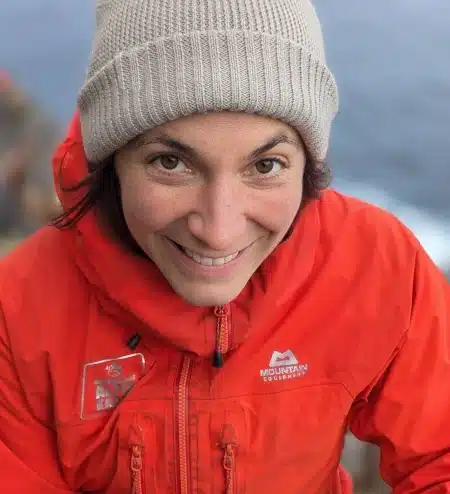
Anna Truntschnig comes from Carinthia and discovered climbing in 2016 – and has been hooked ever since. What fascinates her about alpinism is its versatility: ice, mixed, rock – each discipline demands something different, there's always something new to learn, and that's precisely what appeals to her. For three years, Anna was part of the Austrian Alpine Club's (Naturfreunde) alpine team, culminating in an expedition to Kyrgyzstan. For Anna, climbing combines a thirst for adventure, the joy of movement, and camaraderie – because the most beautiful moments are those shared together.
That might interest you
- Attitude counts – even away from the wall
- Between granite and sandstone: the Totem Cams put to the test
+ + +