


The hook is too close, your hips are too stiff, and everything on the wall feels uncomfortable? With these five stretches, you can specifically work on your climbing flexibility.
A round of stretching after the session – this is something that many climbing fans don’t get enough of. While classic strength or Finger training While they enjoy great popularity, flexibility and mobility are often underestimated, especially in recreational sports. This is unjustified: With just a few exercises, beginners and advanced athletes alike can make great strides—and not just figuratively.
Targeted exercises for typical climbing moves
Whether in the gym or on the rock, bouldering or on a rope – some climbing movements are simply encountered time and time again. With targeted stretching exercises, you can effectively improve these five typical techniques:
- tight heel hooks
- wide heel hooks
- open hips against the wall
- Frontal splits with hip rotation
- active drop knees
Tight heel hooks
Heel hooks, which are placed very close to the body, require hip flexion and external rotation. You can train both by moving your upper body toward your front leg with your knees bent at 90 degrees. Important: Your chest should go toward your knee, not your foot—and don't forget to switch to the other side.

Wide heel hooks
Wide heel hooks are often encountered in compression bouldering. Unlike a narrow heel hook, the hamstring is significantly more involved because the hooking leg is much more extended. You can improve your hamstring flexibility with a frontal hip stretch—as well as the required hip flexion and abduction. Important: Work your way up to the exercise slowly and increase the stretch over time.

Open hips on the wall
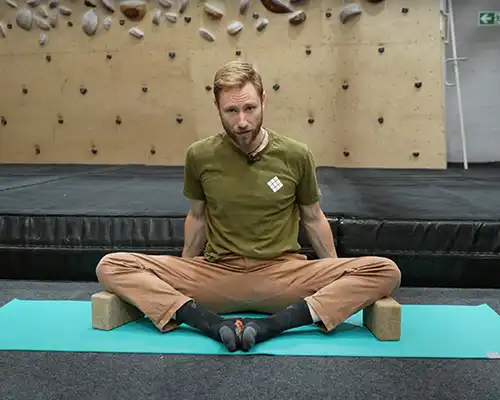
Keeping your hips open and close to the wall isn't just important on the bench: powerful pulls can also be compensated more effectively with hip movement in overhangs. With the "Butterfly," you can individually improve and continually increase your hip opening—from initial support to additional weights on your knees. Hold this static stretch for 30 to 60 seconds.
Frontal splits with hip rotation
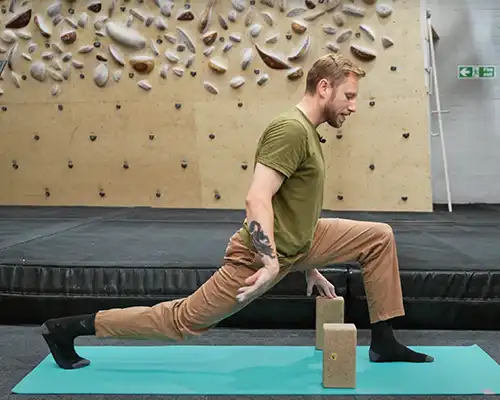
This doesn't mean a complete split like in gymnastics, but rather the climbing position, when we place weight on two widely separated footholds. Being able to rotate your hips inward despite the frontal position reduces the strain on your arms enormously.
The prerequisite for this is hip extension, which you can train with a frontal and wide lunge. You extend the back leg, but your upper body remains in position. Here, too, you alternate between both sides.
Active drop knees
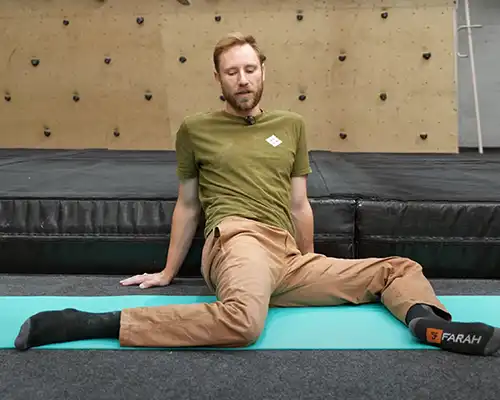
Drop knees are extremely useful for climbing, but they also put a strain on our knees. The reason: We place weight on our leg while simultaneously internally rotating the knee and hip. To improve this, assume a position with your knees bent at a 90-degree angle, as in the exercise for close heel hooks (see above). Instead of rotating toward your front leg, rotate your upper body and move your hips toward the ground.
Important: Even a small range of motion is enough to achieve a noticeable stretch—so you don't have to overdo it to see the effects. Remember to alternate between the two sides during this exercise, too.
All exercises to watch and participate in
In the video by Latex All stretching exercises are clearly summarized again – ideal for trying out directly in the next session or at home on the yoga mat.
That might interest you
- Climbing training on rings: exercises and tips
- Finger strength: Training exercises and methods in the ranking
+ + +
Credits cover photo: Lattice training