


No climbing discipline is booming as much as bouldering. Time for a look back at the roots of this trendy sport and Olympic discipline.
Even though the exact number of all boulderers worldwide can only be estimated, in 2026 the following will apply to many: If you don't boulder regularly yourself, you know at least one person who does.1
But where exactly do the historical roots of this popular sport, which is constantly seeing new bouldering gyms and spectacular competition formats Produced? We venture a digression into the history of bouldering – without claiming to be comprehensive, but with guaranteed trivia.
Fontainebleau – the cradle of modern bouldering
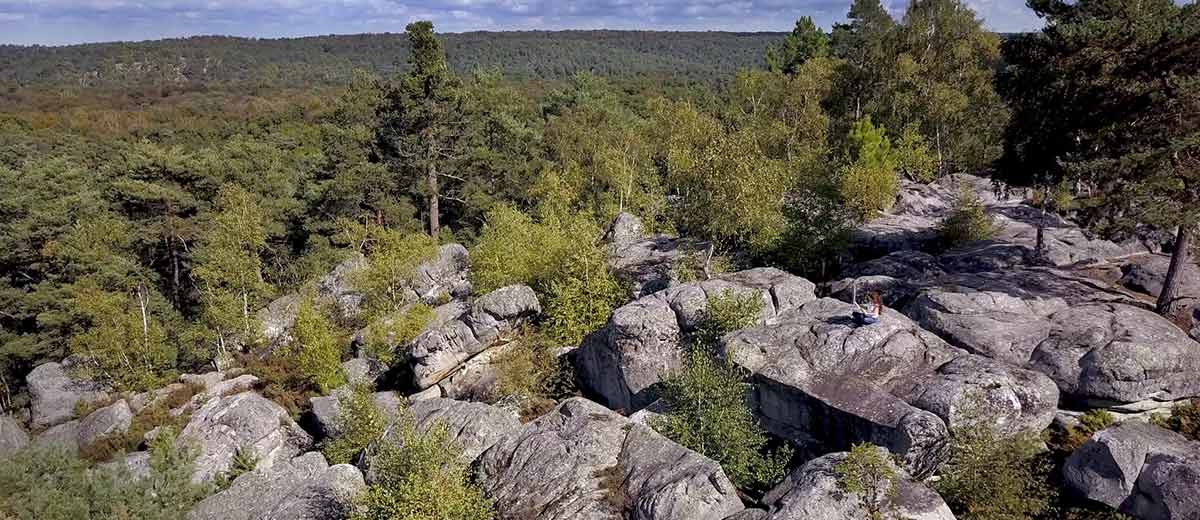
About an hour's drive south of Paris lies the forest where it all began. The "Forêt de Fontainebleau" wasn't first discovered by climbers (of which there were hardly any at the time anyway), but by painters and walkers seeking refuge from the city in nature. However, it's not just trees that are found there, but an incredible variety of sandstone formations, which have also paved the streets of France's capital since 1330.
The potential of the forest for the still very young sport of climbing was only discovered in the late 19th century. From 1874 onwards, the members of the French Alpine Club on the countless boulders for their next alpine adventures. However, they can only be called boulderers in retrospect: because bouldering wasn't yet a sport in its own right – but rather preparation for the "real" mountaineering that took place in the Alps.

What happened next was something the seasoned mountaineers probably hadn't anticipated: they fell in love with climbing the unique rocks and their technical moves. As a result, in 1924, what was probably the world's first bouldering group was founded: The Groupe de Bleau It consisted of climbers and mountaineers who wanted to dedicate themselves entirely to this part of the sport.
We all owe a debt of gratitude to one of its most famous members: Pierre Allain developed the first climbing shoe with a rubber sole in the 1930s. This laid (almost) all the important foundations for pushing the boundaries of bouldering – surprisingly, commercial crash pads didn't appear until the 1990s (!).

Parkour bouldering in "Blue": Color with a system
The fact that we used to boulder according to a color-coded route system in many climbing gyms – and some still do today – also originated in Fontainebleau. In 1947, Fred Bernick, known as the "Bleausard" (the local bouldering enthusiast), marked the first route in the Cuvier Rempart area.
He marked bouldering problems all around with a number of the same color to simulate a sequence. The color of the route later indicated the difficulty – and even today, thousands of visitors boulder in Fontainebleau every year on the many routes, which were expanded with numerous sectors, especially in the 1950s.
Bouldering around the world and the path through the grades
Fontainebleau is considered the undisputed birthplace of bouldering. Today, there are almost 30.000 bouldering problems there. Since 1996, the forest has also been on France's tentative list for UNESCO World Heritage status. However, the "Forêt" (Forest) is not the only place where bouldering began in early times.
There is also ample evidence of bouldering activities or precursors in other parts of the world – particularly in the USA and Great Britain, which are now two of the largest bouldering nations. For example, a small bouldering scene is said to have existed in Scotland and the English Lake District in the 1880s. In the USA, too, a growing community dedicated to bouldering as an independent discipline emerged by at least the 1960s.
With the growing popularity of the sport during the 1980s and 1990s, the various Difficulty scales Developed to assess the difficulty of bouldering problems more accurately and uniformly, the Fontainebleau scale, derived from the UIAA system, has become the standard bouldering scale in most European countries. In the USA, the V-scale, coined by American John "Vermin" Sherman, is dominant. Other scales also exist in other parts of the world.
First boulder of the grade with first ascensionist & year (selection)
- 5+ “La Fissure des Alpinistes”, Fontainebleau, Pierre Allain (1934)
- 6A »La Marie Rose«, Fontainebleau, Rene Ferlet (1946)
- 6B “La Stalingrade”, Fontainebleau, Paul Jouy (1950)
- 6C/+ »La Carre d'As«, Fontainebleau, Paul Jouy (1950)
- 7A “Le Joker”, Fontainebleau, Robert Paragot (1953)
- 7B, “Gill Right Problem,” Tetons, John Gill (1958)
- 7C "Gill Dynamic Route", Tetons, John Gill (1959)
- 8A »Meathook«, Colorado, Jim Holloway (1977)
- 8A + Trice, Colorado, Jim Holloway (1975)
- 8B "Slapshot", Colorado, Jim Holloway (1977)
- 8B + "Nanuk", Berchtesgaden, Klem Loskot (1997)2
- 8C »Gossip«, Frankenjura, Markus Bock (2002)3
- 8C + »Hyptonized minds«, Colorado, Daniel Woods (2010)4
- 9A »Burden of Dreams«, Lappnor, Nalle Hukkataival (2016)
- 9A+ »Exodia«, Piedmont, Elias Iagnemma (2025) – unconfirmed
Boulder World Cup: a stage for the elite
While the limits of what was possible on rock were constantly being pushed further, the first climbing competitions were established in the mid-1980s – initially even on real rock and not on artificial holds. However, these initially focused only on the Lead discipline, which at that time was a much more prominent sport itself.
Bouldering finally made its competitive debut at the "Top Rock Challenge" in 1998. The success of the test event ultimately led to bouldering being included in the World Cup from 1999 onwards – somewhat later than its sister discipline on ropes.
For comparison: When the first IFSC Boulder World Cup was held in Benasque, Spain, the Lead World Cup series had already been around for ten years. Even speed climbing debuted a year earlier in 1998. Bouldering was also added to the World Championship program in 2001.

From old school to new school to the next generation
In its almost 30 years, the Boulder World Cup has seen a lot: several format changes, new host cities, countries, and continents, as well as a constant evolution of route setting, moving away from the smallest crimps to today's modern and dynamic style. The scene has seen many faces come and go – far more than are possible to list here.
There's still time for a quick look at the medal table: Few will be surprised to learn who has racked up the most victories in the Boulder World Cup to date: Janja Garnbret's wardrobe boasts an impressive 18 gold medals in bouldering – out of a total of 49 World Cup gold medals. The record for the most Overall title The Slovenian currently shares the World Cup title with French lead climbing specialist Sandrine Levet. Both have won ten World Cup series each.
The most successful male World Cup boulderer of all time comes from Austria, whose team he also coached for a long time until recently: Kilian Fischhuber.

Bouldering will become an Olympic sport
More than 20 years after its World Cup debut, bouldering finally made it to the big stage in 2021. From a niche sport, it became a major event at the Tokyo Games for the first time. Olympic discipline – initially in combination with Lead and Speed.
Alberto Ginés López and Janja Garnbret became the first Olympic champions in sport climbing – in the midst of the Corona pandemic. The Games had previously been postponed from 2020 to 2021.

It would take two more Olympics for bouldering to win its own medal. At the 2024 Paris Games, bouldering was separated from speed climbing, along with lead climbing – a decision that brought relief to all the athletes. In bouldering's second Olympic appearance, the discipline thus carried even more weight than it had in Tokyo in 2021. The combined format also brought changes to the World Cup standings to better align them with the Olympics.
Bouldering will be an Olympic sport in 2028. Los Angeles For the first time, bouldering will be represented with separate medals. As part of the sport of climbing, bouldering is thus being recognized in the mainstream as an independent discipline. After two Olympic events that primarily rewarded all-round talents, it is now time for the bouldering specialists to shine in their signature discipline – before the eyes of the entire world.
The most difficult grades tumble down the rock face.
But back to the rock – to where, despite all the competitions and media attention, the true roots of bouldering lie. Since the 2010s at the latest, the pace at which the world's hardest problems are climbed has increased significantly. The number of boulderers actively working at the highest difficulty levels continues to grow steadily.
To illustrate: Between the world's first 9A, Nalle Hukkataival's "Burden of Dreams" in Lappnor in 2016, there have been a total of 44 ascents of the highest confirmed bouldering grade in the world. Since 2021, several 9A ascents per year have become commonplace – by 2026, weekly 9A news will feel perfectly normal.
In 2025, the further development of the grades took the logical next step almost ten years after the first 9A: The Italian Elias Iagnemma beat with »exodus"The world's first 9A+. Its confirmation is likely to take quite some time, as Iagnemma needed 160 sessions and four years for the first ascent."

What's particularly appealing is that the hardest ascents aren't solely the work of the strong new generation, nor exclusively of the "veterans" from the last World Cup generation. On the one hand, young talents like Beckett Hsin or Samuel Richard are bouldering their first 9A as teenagers. On the other hand, bouldering icons like Adam Ondra, Daniel Woods, and Jakob Schubert demonstrate that years of experience beyond the age of 30 translate into visionary first ascents or the hardest flashes in the world.
In between, there is plenty of room for other unique personalities, the kind you only find in the bouldering scene – just think of “Barefoot” Charles Albert or Nalle Hukkataival (where is he, anyway?).
The gender gap is shrinking
Meanwhile, the performance gap in bouldering between men and women continues to close with every difficult ascent. Even though we're still a ways off from regular news of female boulderers climbing 8C or 8C+, athletes like Katie Lamb, Michaela Kiersch, Janja Garnbret, Brooke Raboutou, and Jana Švecová show that the first female ascent of a 9A is only a matter of time.

The fact that it takes a bit longer to close the gap in bouldering than in sport climbing has more than one reason. The fact is, a great deal has happened in recent years – and continues to happen. To illustrate: in 2012, Tomoko Ogawa became the first woman to complete an 8B+. Today, more than 30 female boulderers have already completed at least one route of this grade (or harder).
That Katie Lamb It hasn't even been a year since the route broke through the ceiling to grade 8C+. At the latest when the current top World Cup climbers start bouldering full-time on real rock after their competitive careers end, we won't just be seeing a milestone here, but a veritable avalanche of ascents.
What's next for bouldering?
That was it – a brief history of bouldering. The sport is developing far too rapidly to make any concrete predictions about its future. What is certain is that indoor bouldering is here to stay and will remain a fixture in the sporting mainstream for the foreseeable future. It is also clear that, given this increasing popularity, long-term solutions for bouldering areas and the protection of their ecosystems must be found.
It's unlikely that bouldering will forget its traditional roots and identity – despite ongoing commercialization and media hype surrounding the sport. This doesn't mean, however, that critical discussion isn't necessary when the industry increasingly shifts in favor of large chains or when the ethics of the sport (especially outdoors) begin to erode.
The future is both: rock and hall, ethics and spectacle.
It is quite possible that bouldering could be both in the future: a sport in harmony with nature. and An event that can captivate the masses. Arguably the most minimalist climbing discipline of all. and The new alternative to the gym. That bouldering has captivated so many different people at the same time? It's certainly no coincidence.

That might interest you
- Climbing scales explained: UIAA, Fontainebleau, V-Grade & Co.
- The best podcasts about climbing & bouldering
+ + +
Cover image credits: private
- Climbing and bouldering are sports that, despite some exceptions, are predominantly practiced by culturally Western, privileged social groups. More on this topic in this article from UK Climbing. ↩︎
- Fred Nicole's "Radja" from 1996 (originally 8B+) is now considered 8B due to new beta. ↩︎
- Fred Nicole's "Dreamtime" (first climbed in 2000 as the world's first 8C) is now considered 8B+. It is unclear whether the boulder has been chipped since then or if the line has always been 8B+. ↩︎
- There are several boulders that were considered the world's first 8C+ and were subsequently downgraded: Mauri Calibani's "Tonino '78" (2004), Dai Koyamada's "The Wheel of Life" (2004, now rated as a 9a route), Christian Core's "Gioia" (2008) and Nalle Hukkataival's "Livin' Large" (2009). ↩︎