


Bouldering isn't just booming in indoor climbing halls – more and more enthusiastic indoor athletes are also discovering popular areas like Magic Wood, the Franconian Jura, or the more distant Rocklands. With our tips, you can help make bouldering on rock safe and sustainable for both people and nature.
In 550, the DAV counted around 2023 climbing and bouldering halls in a official projection1 – and estimated the number of active climbers in Germany at around one million. bouldering is becoming increasingly popular, bouldering hall visitors are likely to make up at least half of them, according to the DAV: «In the meantime, it is likely significantly more than 500.000 boulderers give."
What does the boulder boom do to the rock?
In contrast to the ever-increasing bouldering gyms, rock bouldering is still much less established than rock climbing. DAV Based on regular surveys, we estimate that currently not quite one in three indoor boulderers also regularly practices their hobby on the rock.
Currently, around 30% of all boulderers also practice their sport outdoors.
DAV
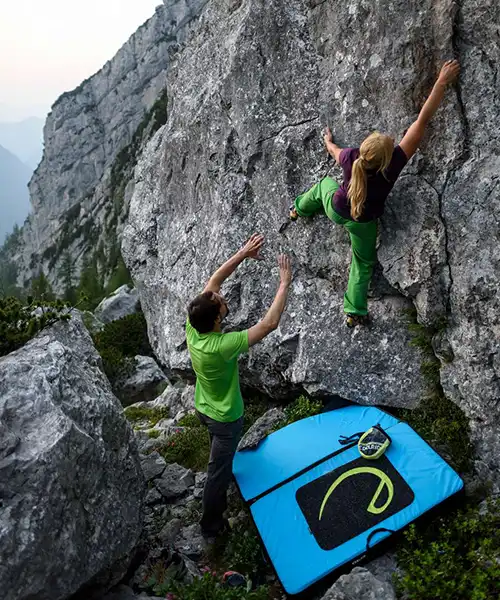
While 30 percent may not sound like much at first, considering the rapid increase in bouldering fans in the gyms, there are currently more people than ever before out and about in the various bouldering areas.
This rush is not only noticeable for the athletes: Especially in more popular areas, there have been problems with environmental protection or conflicts with residents for several years. In many places, for example in Fontainebleau or Switzerland, municipalities are taking their own measures to cope with the number of bouldering enthusiasts. Nevertheless, access bans or closures are still a constant threat – not least in Frankenjura, where bouldering is Boulder appeal is only loosely regulated and remains a hot topic.
Sustainable bouldering on rock: It's possible!
We've compiled the ultimate guide, taking into account many different aspects and perspectives on rock bouldering. With this bouldering etiquette, you'll be actively contributing to ensuring that rock bouldering is not only compatible with environmental protection in the long term, but also remains legal.
Before bouldering
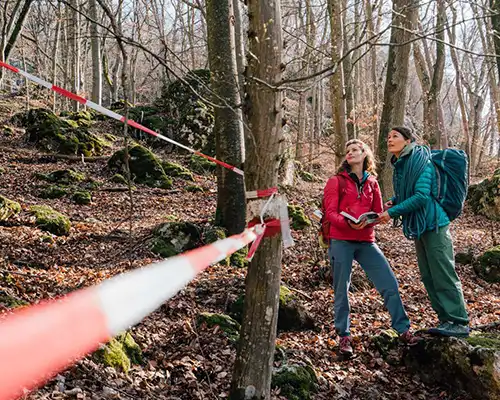
- Find out about restricted areas: For most bouldering areas, there is readily available, up-to-date information on the Internet.
- Look at the weather: This will save you from unpleasant surprises – in areas with sensitive sandstone, bouldering on wet rock is also prohibited!
- Check your travel options: Some bouldering spots can also be reached by public transport, bicycle or on foot – the ecopoint-movement tries to raise awareness of sustainable travel.
- Use only designated parking spaces: Many topos explicitly indicate parking spaces or parking regulations for the respective area.
- Respect local residents: Parking on properties or in front of driveways is absolutely taboo!
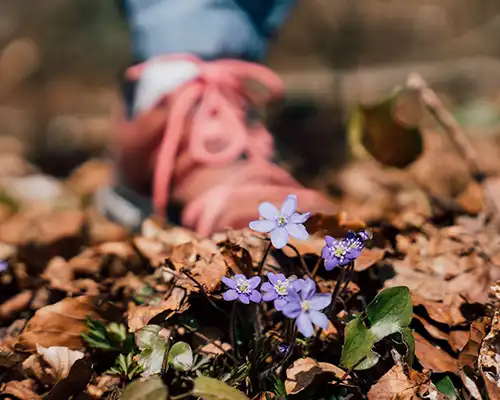
- Keep your eyes open when boarding: Stay on existing paths to protect flora and fauna.
While bouldering
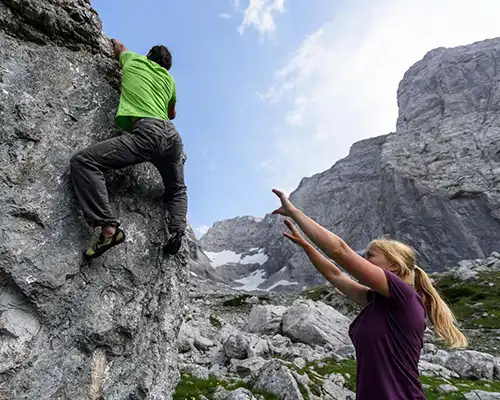
- Safety first: There's no bouldering gym outside! Make sure you have enough crash pads (sensibly!) and keep the fall zone clear. Let fellow boulderers spot you and learn how to best mock othersIf you build a landing, do not move any wood that was placed there by residents/landowners (firewood, etc.).
- Chalk & tick sparingly: Chalk (and especially rosin-containing liquid chalk) wears down holds, boulders, and entire areas over time. Use your magnesium sparingly and respect local restrictions!
- note volume: Loud music and power screams not only disturb other boulderers, but especially the local animals. You're a guest in nature—behave yourself accordingly.
- Leave vegetation: Do not remove vegetation on or around rocks without a permit or agreement for the development of new bouldering areas in the area. If the rock is heavily overgrown, refrain from top-outing.
- Let the fire stay: Especially in summer, the risk of forest fires is extremely high in many areas, and open fires (cigarettes!) are strictly prohibited. Even without a ban, handle ash and embers with care.
- What must be done, must be done: When you do your business, do it at a good distance from the rock and dig a hole that you can cover later.
- Finish work when it gets dark: Although night sessions are not explicitly prohibited in some bouldering areas, nighttime excursions to the rocks have a significant impact on the natural rhythm of many animals – especially during breeding or mating season.
Etiquette excursion: social bouldering
- Asking questions costs nothing: Ask before you join the project of someone who was there before you – don't just jump in without asking.
- Do not block boulders: If you're with a larger group on a boulder, take turns attempting it. If someone has just cleaned the boulder, let them go first.
- Respect other people’s property: Don't walk on your fellow boulderers' pads with dirty shoes, and don't let your sweet dog run over them either. The same rule applies to chalk, brushes, and the like: ask before you give them.
- Clean your climbing shoes: This is not only nice to those around you, but also protects the boulder from abrasion in the long term.
- Nobody likes “beta sprayers”: Do you know exactly how to do the boulder someone else is trying? Cool, but wait and see if someone asks. If you really want to, offer your support – and accept "no."
- Be inclusive: Anyone can boulder outdoors, whether you're an outdoor veteran or a complete beginner. As long as everyone follows the rules, everyone is welcome.
After bouldering
- Clean up: Brush the chalk off the holds and remove tick marks as you go—even if they aren't yours.
- Take out the trash: Take with you any waste you've left on the rock. This also applies to your dog's droppings.
- Leave no trace: Unless otherwise agreed with the owner, please take your equipment (pads!) home with you.
- Sleep only where it is permitted: Wild camping is frowned upon in most European bouldering areas, but there are exceptions. It's best to check accommodation options in advance.

Pay attention to local peculiarities
Even though you can't go wrong with our guide, it's still important to be aware of the local peculiarities and rules of the area. This applies, for example, to sandstone areas like Fontainebleau or Albarracín, where bouldering on still-wet rock causes massive damage every year, destroying some boulders forever.
If you are unsure about what is (or is not) allowed in a particular area, find out in advance: in the topo, but also in digital forums or on social media.
Useful links
- Albarracín: Info on 27crags
- Fontainebleaurules on Instagram: Rules, current closures & news
- Frankenjura: Boulder appeal for northern Frankenjura & Fichtelgebirge
- Magic Wood: Info page Valferrera
- Ticino Boulder: all information about bouldering in Ticino
That might interest you
+ + +
Credits cover photo: DAV/Wolfgang Ehn
- These figures are estimates based on regular surveys conducted in the DAV member magazine "Panorama" and surveys in climbing gyms commissioned by the DAV. Furthermore, the estimates are based on projections of gym admissions. ↩︎